Category: Course Creation

  • how to structure an online course curriculum

    how to structure an online course curriculum

    Unlock Curriculum Success: The Ultimate Blueprint for Your Online Course Structure

    The Million-Dollar Knowledge Mine: Why Coaches & Speakers MUST Create Their Own Effective Course Now

    Listen up, fellow impact-makers…

    You’ve spent YEARS mastering your craft. Countless hours on stages, in coaching sessions, transforming lives with your unique expertise.

    But here’s the brutal truth: You’re leaving MOUNTAINS of cash on the table if you’re not packaging that wisdom into your own signature course.

    I’ve helped coaches turn their knowledge into $50K/month passive income streams. The secret? It’s not just throwing together some videos and crossing your fingers.

    It’s about creating an IRRESISTIBLE learning journey that hooks your ideal clients and transforms them so profoundly they can’t stop talking about you.

    Why Most Coaches FAIL at the Course Curriculum Stage (And How You’ll Succeed)

    Your audience is DROWNING in mediocre courses. The market is saturated with “meh” content that promises transformation but delivers disappointment.

    This is actually FANTASTIC news for you.

    Because while everyone else is creating forgettable content, you’re about to architect a learning experience so powerful, so results-driven, that your students will become your most passionate evangelists.

    The difference between an average course and a best-selling course isn’t just better lighting or fancier slides. It’s STRUCTURE. It’s the invisible architecture that guides your learners from confusion to clarity, from frustration to freedom.

    Your Course Is Your Legacy (And Your Retirement Plan) – So You Need the Right Step-By-Step Guide

    Think about this: Every coaching call, every speech you give is a ONE-TIME exchange of your energy for money.

    But your course? That’s you getting paid while you sleep. While you vacation. While you focus on only the clients who truly light you up.

    I’ve watched speakers who were burning out from constant travel create courses that generated more revenue than their speaking gigs – with NONE of the airport hassles.

    I’ve seen coaches expand their impact from dozens of clients to THOUSANDS through strategically structured courses.

    This isn’t just about making money. It’s about SCALING YOUR IMPACT in a way that honours your expertise and creates freedom in your business.

    The Template That Turns Your Knowledge Into Gold

    The difference between courses that sell and courses that SELL OUT comes down to how you structure the learning journey.

    Your students don’t just want information – they want TRANSFORMATION.

    They don’t want more to-do lists – they want RESULTS.

    And the path to delivering that starts with a framework that guides them step-by-step from where they are to where they desperately want to be.

    Are you ready to turn your hard-earned wisdom into a legacy that pays you for DECADES to come?

    Are you ready to stop trading time for money and start making an impact that scales beyond what you could ever achieve one-on-one?

    The world NEEDS your expertise packaged in a way they can consume, implement, and benefit from – even when you’re not in the room.

    Your course isn’t just another digital product. It’s the ultimate expression of your mission, packaged for maximum impact.

    The only question is: Are you ready to build it the RIGHT way?

    Why Structure Matters: More Than Just a Pretty Outline

    Think of your online course as a house. Without a solid foundation and a well-thought-out blueprint, it’s going to crumble. A well-structured course:

    • Boosts Completion Rates: A clear path keeps students motivated and less likely to drop out.
    • Enhances Learning: Organised content makes it easier for students to absorb and retain information.
    • Increases Engagement: Interactive elements and a logical flow keep students actively involved.
    • Improves Perceived Value: A professional structure elevates the perceived value of your course, justifying the price.
    • Creates Transformation: A shift in beliefs. A shift in identity. Dismantling the inner blocks to success. A behaviour change.

    Building Your Course Content: The Core Components

    The Gap-Mapping Manifesto: How to Create A Course Design That Actually Transform Lives

    Look, here’s the brutal truth about most online courses:

    They’re information dumps masquerading as transformation vehicles.

    And your students? They’re drowning in a sea of “how-to” videos while their actual problems remain unsolved.

    But what if you could build a course that doesn’t just teach—but actually bridges the painful gap between your students’ current mess and their desired paradise?

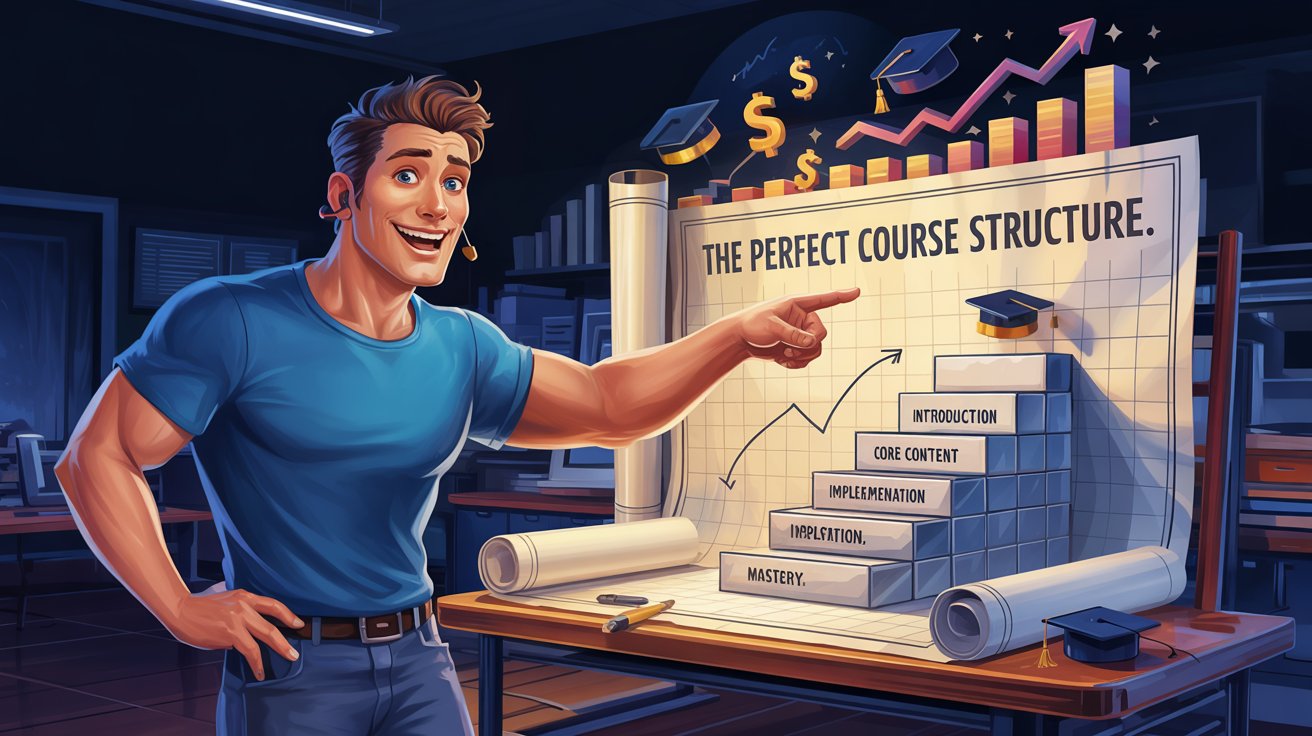
    The Transformation Bridge: Your New Course Architecture

    Your students aren’t buying your course because they want more information. They’re buying because they’re stuck in a place that HURTS, and they’re desperate for someone to guide them across the chasm to relief.

    This isn’t about modules and lessons. This is about mapping the emotional and practical journey from their current state of frustration to their dream outcome.

    Here’s how to architect that journey using the 4MAT system that speaks to every learning style:

    1. WHY – Hit them in the gut with why this matters

    2. WHAT – Give them the concept that changes everything

    3. HOW – Show them the exact steps to implement

    4. WHAT IF – Expand their vision of what’s possible

    The 5 Critical Components of Your Transformation Machine

    1. The Grand Entrance: Your Course Introduction

    From “What did I just buy?” to “Holy course creation, this is exactly what I need”

    – WHY: Name their pain so accurately they feel seen. “You’ve tried everything, but you’re still stuck in [specific painful situation].”

    – WHAT: Show them the promised land. “Here’s exactly what you’ll be able to do by the end of this course.”

    – HOW: Position yourself as their sherpa. “I’ve guided X people through this exact journey, and here’s how we’ll do it together.”

    – WHAT IF: Plant the seed of possibility. “Imagine waking up and finally [specific desired outcome].”

    2. Laying the Foundation: Your Foundational Modules

    From “I don’t know where to start” to “I finally understand how this works”

    – WHY: Connect these basics to their biggest dreams. “Most people skip this foundation—that’s why they fail at [big goal].”

    – WHAT: Reframe the fundamentals as secret weapons. “These aren’t just basics—they’re the hidden levers that change everything.”

    – HOW: Break it down into baby steps that build confidence. “Let’s start with just this one small action that creates momentum.”

    – WHAT IF: Warn them about the traps. “Here’s where most beginners go wrong, and how you’ll avoid those pitfalls.”

    3. The Heart of the Matter: Your Core Content Modules

    From “This seems complicated” to “I can actually do this”*

    – WHY: Remind them what’s at stake. “This is the exact skill that separates those who [succeed] from those who [remain stuck].”

    – WHAT: Deliver your proprietary navigation framework. “Here’s my unique 3-step system that simplifies everything.”

    – HOW: Show, don’t just tell. “Watch over my shoulder as I demonstrate exactly how to [complete key task].”

    – WHAT IF: Help them make it their own. “Here’s how to adapt this for your specific situation, even if [common objection].”

    4. Reinforcement & Application: Your Feedback Systems

    From “Am I doing this right?” to “I’m seeing real progress”

    – WHY: Create urgency around implementation. “The difference between knowledge and transformation is this step right here.”

    – WHAT: Frame the assessment as a breakthrough tool. “This isn’t just a quiz—it’s your personalized roadmap.”

    – HOW: Make feedback immediate and actionable. “Complete this challenge and get instant clarity on your next move.”

    – WHAT IF: Turn mistakes into stepping stones. “If you’re struggling with X, here’s exactly what to adjust.”

    5. The Final Flourish: Your Course Conclusion

    From “What now?” to “I’m unstoppable”

    – WHY: Celebrate their transformation. “Look at what you’ve overcome—remember where you started?”

    – WHAT: An end of the course review. Cement their new identity. “You’re no longer a person who [old limitation]. You’re now someone who [new capability].”

    – HOW: Give them an instructional sustainability plan. “Here’s exactly how to maintain your results, even when [common obstacle] happens.”

    – WHAT IF: Expand their horizon. “Now that you’ve mastered this, what becomes possible in your life?”

    The Bottom Line: Your Target Audience. Their Pain Points

    Anyone can create a course that delivers information.

    But if you want to create raving fans who get real results and tell everyone they know about you?

    Build a transformation bridge that maps the gap between their pain and their paradise.

    That’s not just good course design. That’s a business-changing, life-changing revolution.

    FAQs: Your Burning Questions Answered

    • How long should each module be? Aim for modules that are 30-60 minutes in length. This allows for focused learning without overwhelming students.
    • How much content is too much? Focus on quality over quantity. Provide valuable, actionable content that is relevant to the learning objectives.
    • Should I include downloadable resources? Absolutely! Checklists, templates, and cheat sheets can enhance the learning experience and provide ongoing value.
    • How often should I interact with students? Regularly engage with students through Q&A sessions, forum discussions, and personalized feedback.
    • What platform should I use to host my course? Research different platforms like Teachable, Thinkific, or Kajabi to find one that fits your needs and budget.

    Statistics to Consider

    • According to a study by Teachable, the average completion rate for online courses is only around 3-15%. A well-structured course can significantly increase this rate.
    • Research shows that students who actively engage with course content are more likely to retain information and achieve their learning goals.
    • Online learning is a rapidly growing market, with projections estimating it to reach $325 billion by 2025.

    Level Up: Advanced Structuring Strategies

    • Gamification: Incorporate game-like elements, such as points, badges, and leaderboards, to motivate students and increase engagement. Think about awarding points for learning outcomes, completing modules, badges for mastering specific skills, and creating a leaderboard to foster healthy competition. You can use tools within your chosen platform or integrate third-party gamification apps. Consider offering bonus content or exclusive access to a community for top performers.
    • Community Building: Create a sense of community by fostering interaction among students through forums, group projects, and live sessions. A dedicated forum or Facebook group can provide a space for students to ask questions, share their experiences, and connect with one another. Facilitate group projects that require collaboration and teamwork. Host regular live Q&A sessions or webinars to address student concerns and build a stronger connection.
    • Personalised Learning: Tailor the learning experience to individual student needs through adaptive learning technologies and personalised feedback. Implement quizzes or assessments at the beginning of the course to gauge students’ existing knowledge and skills. Use this information to recommend specific modules or resources that are most relevant to their needs. Provide personalised feedback on assignments and projects, focusing on their strengths and areas for improvement. Consider using adaptive learning platforms that adjust the difficulty level based on student performance.
    • Micro-learning: Break down complex topics into bite-sized chunks of content that are easier to digest and retain. Instead of long, comprehensive videos, create shorter, focused videos that address specific concepts or skills. Use infographics, checklists, and other visual aids to summarise key information. Offer quizzes and assessments after each micro-learning module to reinforce learning.
    • Storytelling: Weave compelling stories and real-world examples into your course content to make it more engaging and relatable. Share your own experiences and challenges to connect with students on a personal level. Use case studies to illustrate how the concepts you’re teaching can be applied in real-world situations. Encourage students to share their own stories and experiences in the community forum.

    Choosing the Right Technology: Your Online Course Platform

    Selecting the right platform to host your online course is a crucial decision. There are numerous options available, each with its own strengths and weaknesses. Consider factors such as:

    • Ease of Use: Is the platform user-friendly for both you and your students?
    • Features: Does it offer the features you need, such as video hosting, quiz creation, and community forums?
    • Pricing: Does it fit your budget?
    • Integration: Does it integrate with other tools you use, such as your email marketing platform?
    • Scalability: Can it handle your growing student base?

    While platforms like Teachable, Thinkific, and Kajabi are popular choices, one platform stands out for its robust features, affordability, and seamless integration: ThriveCart Learn+.

    ThriveCart Learn+ offers a comprehensive suite of tools for creating, selling, and managing your online courses. Its intuitive interface makes it easy to build engaging lessons, create quizzes and assignments, and track student progress. Plus, its powerful marketing and sales features allow you to easily promote your course and generate revenue. With its lifetime pricing option, ThriveCart Learn+ offers exceptional value for course creators of all levels.

    Conclusion: Your Path to Create a Course Which Nails It

    Creating the perfect online course structure is an ongoing process. By focusing on clear learning objectives, engaging content, a logical flow, and the right technology, you can create a course that delivers exceptional value and helps your students achieve their goals.

    Consider ThriveCart Learn+ as a powerful and affordable platform to bring your course to life. So, take this blueprint, adapt it to your specific needs, and start building your own path to online course success!


  • how to create online courses from scratch

    how to create online courses from scratch

    7 Simple Steps to Create And Sell Your First Online Course (Even If You’re a Complete Beginner)

    The $375 Billion Online Course Secret They Don’t Want You to Know

    Look, I’m going to be blunt here.

    While you’re sitting there wondering if you have what it takes to create an online course, thousands of people with LESS knowledge than you are cashing in BIG TIME.

    I’m talking about ordinary people who are waking up to payment notifications while you’re still hitting the snooze button on your dreams.

    The online learning industry is projected to hit $375 BILLION by 2026. That’s not just money changing hands. That’s a WEALTH TRANSFER happening right now.

    And you’re either going to be on the receiving end… or you’re going to be left behind.

    Two years ago, I was exactly where you are. Doubting myself. Overthinking everything. Making excuses.

    Then I discovered a simple 7-step system that changed everything. I’ve now launched multiple courses, served thousands of students, and built a “make money while I sleep” business that my past self wouldn’t believe.

    The best part? I didn’t need special connections, fancy degrees, or technical wizardry.

    I just needed this roadmap I’m about to hand you on a silver platter.

    Ready to sell an online course?

    Step 1: Before You Create An Online Course Find Your Money-Magnet Topic (Hint: It’s Not What You Think)

    Here’s the brutal truth most “gurus” won’t tell you:

    Nobody cares about your passion. They care about their PROBLEMS.

    Your winning course topic isn’t about what excites you. It’s about what keeps your ideal customers awake at 3 AM, desperately Googling for solutions.

    💰 Try my “Pain-to-Profit” method for choosing a course topic:

    1. Make a list of problems you’ve personally solved (even if it seems “too simple” to you)
    2. Spy on your market using these goldmines:
       – Reddit threads where people are BEGGING for help
       – Amazon book reviews where readers complain “this didn’t solve my problem”
       – Facebook groups where the same desperate questions pop up weekly
    3. Look for problems where people are already throwing money at half-baked solutions

    Example: Don’t create a generic “how to write better” course. Create “The 5-Day Email Sequence That Converts Subscribers Into $997 Clients (Even If You Hate Selling)”. Make your course answer a specific problem.

    Remember: The riches are in the SPECIFIC PROBLEMS you solve, not the general topics you cover.

    Step 2: Get Paid BEFORE You Start Your Course Creation

    Want to know the #1 reason most course creators fail?

    They spend months creating a course NOBODY WANTS.

    Smart creators get PAID FIRST, then create. Here’s how:

    🤑 The “Sell-Then-Build” Method:
    1. Create a mouth-watering course description that focuses on the transformation, not the information
    2. Set up a simple payment page with a “founding member” discount
    3. Sell 5-10 spots before you’ve created a single video

    If people won’t pay for the PROMISE of your solution, they definitely won’t pay for the finished product.

    One student tried to launch a $497 “Instagram Growth” course that NOBODY bought. Then she pre-sold a $997 “Client-Getting Instagram Strategy for Service Providers” course to 7 people in 48 hours.

    The difference? She found a SPECIFIC PAIN that people were willing to pay to solve.

    The “Webinar-to-Wallet” Secret: How to Get Paid Before You Create a Single Lesson

    Forget spending weeks building a course nobody wants. This is my goto strategy – best practise – to validate before I create online courses.

    It’s the ultimate shortcut that lets you validate your idea AND get paid upfront:

    Host a live webinar that sells your course before it even exists.

    I know, it sounds crazy. But trust me, this is how the pros do it.

    Here’s the “Webinar-to-Wallet” formula I’ve used to generate thousands in pre-sales:

    1. Open with the “After” Picture: Don’t talk about features. Paint a vivid picture of the transformation they’ll experience. What will they be able to DO after taking your course? How will their life be different?

    2. Show your Target Audience the Map: Walk through your course outline like it’s a treasure map. Show them the exact steps they’ll take to reach their desired outcome. Make it clear that each piece of the puzzle fits together perfectly.

    3. Sell the Dream: Remind them of the ultimate outcome. Who will they BECOME after completing your course? What will they be able to ACHIEVE? Make them FEEL the possibility.

    4. The “Founding Member” Invitation: Don’t just sell a course. Invite them to join an EXCLUSIVE beta program. Position it as a chance to:
       – Get early access at a STEAL of a price
       – Help SHAPE the course with their feedback (plus testimonials)
       – Become a “Founding Member” with VIP access to you

    This isn’t just about selling. It’s about building a tribe of early adopters who are invested in your success.

    Pro Tip: Ditch the polished presentation. Keep it real, keep it raw, and make it clear that they’re part of something that’s EVOLVING. People love being on the inside.

    The bottom line? Webinars aren’t just for selling. They’re for validating, building excitement, and getting paid BEFORE you put in the hard work.

    Stop guessing and start SELLING. Your bank account will thank you.

    Step 3: Structure Your Course Content Like a Transformation Machine

    Let me tell you a secret that took me years to learn:

    Information is worthless. Transformation is priceless.

    Your course isn’t a collection of videos. It’s a SYSTEM that takes your target audience (the learners) from their painful “before” state to their desired “after” state.

    🧠 Use my “Transformation Architecture” framework:

    1. The Wake-Up Call – Shatter limiting beliefs and create urgency
    2. The Clear Path – Show them the exact roadmap to success (step-by-step)
    3. The Quick Win – Give them an immediate result to build confidence
    4. The Deep Dive – Core training that solves their biggest obstacles
    5. The Breakthrough – Advanced strategies that accelerate results
    6. The New Identity – Help them see themselves as transformed

    🎬 CRUCIAL: Keep videos under 10 minutes. Research shows attention drops by 50% after the 10-minute mark. Your students want results, not your life story.

    Step 4: Choose an Online Course Platform That Makes You Money (Not One That Drains It)

    Listen carefully: The platform you choose can make or break your course business.

    Most beginners make a COSTLY mistake: they choose platforms based on fancy features instead of PROFIT POTENTIAL.

    💻 Here’s what actually matters:

    – Does it let you OWN your customer data? (Critical for repeat sales)
    – Does it take a huge cut of your revenue? (Some take 50%!)
    – Does it make checkout FRICTIONLESS? (Every extra click costs you money)

    My top recommendations based on PROFIT potential:

    🎯 The platform that made me the MOST money wasn’t the fanciest—it was the one that got out of the way and let me SELL. (ThriveCart Learn+)

    As for equipment? Keep it simple:
    – A decent microphone ($60-100)
    – Screen recording software
    – Basic slides

    Your students care about RESULTS, not production quality. I’ve seen $2,000 courses filmed on iPhones outperform studio-quality productions that taught fluff.

    Step 5: Learn How to Create Your Course Content To Get RESULTS (Not Just Compliments)

    Want to know why most courses get abandoned after Module 1?

    They’re BORING information dumps that don’t lead to action.

    Your content needs to be like a good action movie: fast-paced, engaging, and impossible to turn off.

    The learning experience is as important as the learning objectives.

    🔥 My “Action Activation” formula:

    – Start each lesson with a PROMISE: “After this 9-minute video, you’ll be able to…”
    – Teach ONE thing per video (not everything you know)
    – Include EXAMPLES that make concepts real
    – End with a specific ACTION STEP they can complete in 15 minutes or less

    The secret sauce? Course materials which are IMPLEMENTATION ASSETS:
    – Templates they can copy-paste
    – Checklists that make action brainless
    – Swipe files of proven examples
    – Action worksheets that force implementation

    The most successful students don’t just watch my videos—they IMPLEMENT what I teach. And they pay me again and again because I give them RESULTS, not just information.

    Step 6: Build a Sales System That Converts Cold Prospects Into Eager Buyers

    Let’s get real: Creating your course is only 20% of the battle.

    The other 80%? SELLING IT.

    But I’m not talking about sleazy tactics or pushy sales pitches. I’m talking about a SYSTEM that turns the right people into buyers—almost automatically. And those are the kindsof systems you need to learn how to create online.

    📈 My “Desire Escalation” sales system:

    1. Create a free Irresistible Lead Magnet – Solve ONE specific problem for free (but make them hungry for more)
    2. The Relationship-Building Email Sequence – 5-7 emails that demonstrate your unique approach
    3. The “Aha Moment” Webinar – Show them what’s possible and introduce your course as THE solution
    4. The Fear-Dissolving FAQ Page – Address objections before they become roadblocks

    💰 Pricing psychology that WORKS: How to price your course
    – Tiered pricing creates options (Basic, Premium, VIP)
    – Early-bird discounts reward fast action
    – Payment plans remove financial barriers

    One of my students went from struggling to sell a $197 course to easily enrolling students at $997 using this exact system. The difference wasn’t the CONTENT—it was the SALES APPROACH.

    And remember: throughout the course collect feedback and testimonials.

    Step 7: Launch, Learn, and Leverage Your Success

    Here’s where most course creators go wrong: (which is why they’re not successful online)

    They treat their launch like a one-time event instead of the BEGINNING of a profitable journey.

    Your first launch is just a data-gathering mission. The REAL money comes from what you learn and how you adjust.

    🚀 My “Perpetual Profit” launch strategy:

    1. Set a non-negotiable launch date (commitment creates results)
    2. Create genuine urgency with limited spots or bonuses
    3. Go ALL IN on promotion for 7-10 days (this is not the time for modesty)
    4. Personally reach out to potential students who showed interest
    5. Analyse what worked and what didn’t

    After your launch:
    – Survey BOTH buyers and non-buyers
    – Identify where students get stuck
    – Create additional resources for common roadblocks
    – Plan your NEXT launch with improvements

    💬 The million-dollar question to ask buyers:  
    “What finally convinced you to buy?”

    Their answers will become your marketing gold for launch #2.

    Create An Online Course : The Brutal Truth About Course Creation Success

    Let me be crystal clear about something:

    The world doesn’t need more information. It’s DROWNING in information.

    What people desperately need—and will gladly pay for—is TRANSFORMATION.

    They need someone who’s been where they are, who can guide them to where they want to go, who can save them time, money, and heartache.

    That person is YOU.

    Not because you know everything (you don’t).
    Not because you’re perfect (you’re not).
    But because you’ve solved a problem that others are still struggling with.

    The only question is: Will you step up and package your solution into a course that changes lives?

    Or will you keep your knowledge locked away while others with half your expertise cash in?

    The choice is yours. But I hope you choose to join the creators who are building wealth while making a difference.

    Because six months from now, you could be waking up to those Stripe notifications I mentioned.

    Or you could be exactly where you are right now—still wondering “what if?”

    Get started: Create and sell an online course. 

    # 7 Steps to Create and Sell an Online Course on the Best Course Platforms

    FAQ’s

    Frequently Asked Questions on How to Create An Online Course From Scratch

    Q: What are the essential first steps when planning to create your online course?

    A: Starting your journey as an online course creator begins with market research! First, you need to identify what people want to learn and validate the market demand for your course.

    Look at platforms like Udemy and LinkedIn to see what’s popular. Then, create a course outline based on your expertise and the gaps in online education.

    Remember, a successful online course solves specific problems for your target audience. Oh, and don’t skip the competitor analysis – see what others are teaching and how you can make your course even more high-quality!

    Q: How do I choose between platforms like Udemy, Teachable, and Thinkific for selling online courses?

    A: Ah, the platform dilemma! Each has its quirks.

    Udemy gives you instant access to millions of potential learners but takes a bigger cut of your earnings.

    Teachable and Thinkific let you build your own branded school with more control over pricing and marketing. Teachable is super user-friendly with great sales features, while Thinkific offers slightly better course design options.

    Most platforms offer a free trial, so take them for a test drive! Your choice should depend on whether you want to build your own online business or leverage an existing marketplace.

    Pro tip: some creators use multiple platforms – putting a basic course on Udemy and premium offerings on their own Teachable or Thinkific site!

    Personally I use ThriveCart Learn+ . One off investment and full control.

    Q: What equipment do I need to create my online course with professional video production?

    A: Good news! You don’t need a Hollywood studio to create your online course. At minimum, you’ll need a decent smartphone camera (newer models shoot amazing video), a simple clip-on microphone (audio quality matters more than video!), and some basic lighting (even a well-placed lamp can work wonders).

    As you grow, you might invest in a DSLR camera, proper studio lights, and editing software. But please, make sure you’re focusing on valuable content first – learners would rather watch slightly imperfect videos with amazing information than beautiful footage of mediocre teaching.

    Some of the most successful courses on Udemy started with super basic setups!

    Q: How do I structure my course curriculum to ensure learners stay engaged?

    A: Think of your course curriculum like a Netflix series – you want to hook your learners and keep them binge-watching! Start with quick wins to build confidence.

    Break content into digestible 5-10 minute videos (attention spans are tiny these days). Mix theory with practical exercises, and include downloadable resources as part of your course.

    The course you create should follow a logical progression that takes students from A to Z without overwhelming them.

    Include quizzes to reinforce learning and maybe even a certificate at the end! Remember that different people want to learn in different ways, so include text, video, audio, and interactive elements when possible.

    And please, no 60-minute lecture videos unless you want your students falling asleep face-first on their keyboards!

    Q: What marketing strategies work best to get people to enroll in your course?

    A: If you build it, they will NOT come… unless you market it! Start by creating a free course or mini-course as a teaser.

    Use email marketing to nurture leads – maybe offer an email course first to build trust. Leverage social media with video snippets that showcase your teaching style.

    Partner with influencers in your niche who can promote to their audience.

    Consider running limited-time promotions where people can buy your course at a discount.

    And don’t forget the power of testimonials – once you have happy students, their success stories will help you convince others to enroll.

    The most successful course creators spend as much time marketing as they do creating content. Remember: even the best elearning content needs promotion!

    Q: How important is building an online community for my course success?

    A: Building an online community isn’t just important—it’s practically your secret weapon! When students connect with each other, they’re more likely to complete your course and rave about it to others.

    You can create community through discussion forums, Facebook groups, Discord channels, or live Q&A sessions. The online community becomes a place where students help each other, share successes, and stay motivated.

    As a bonus, it’s also your direct line to customer feedback – you’ll learn exactly what your learners love and what you could improve. Plus, engaged communities tend to buy additional courses from you and become your most enthusiastic referral sources.

    Community building might take extra effort, but it’s worth its weight in gold for course completion rates and student satisfaction!

    Q: What are the 10 steps to successfully launch my course once it’s ready?

    A: Launch day jitters? Follow these 10 steps and you’ll be golden!

    1) Beta test with a small group for feedback

    2) Create a compelling sales page that addresses pain points

    3) Set up an email sequence for interested prospects

    4) Prepare promotional video teasers

    5) Line up affiliates or partners who can help promote

    6) Create a limited-time launch discount

    7) Plan a webinar to showcase your expertise

    8) Schedule social media announcements

    9) Personally reach out to your network

    10) Follow up with those who showed interest but didn’t buy.

    Remember, your launch isn’t just about making sales – it’s about creating buzz and collecting testimonials that will help you sell more courses in the future! And please celebrate when people enroll – do a little dance for each student who decides your course will allow them to transform their skills!

    Q: How do I know if there’s market demand for my course before I create it?

    A: Don’t waste months creating a course nobody wants to learn! Test market demand by creating a simple landing page describing your course and collect email addresses from interested people.

    Search sites like Udemy, Skillshare, and Amazon books to see if similar topics are selling well. Use Google Keyword Planner to check search volume for related terms.

    Survey your existing audience or run small social media polls. You could even pre-sell your course at a discount before creating all the content – if people are willing to pay, that’s the ultimate validation!

    The worst thing is spending hundreds of hours creating content only to hear crickets when you launch. Remember, successful online courses solve specific problems people are actively searching for solutions to!

  • How to Price Your Online Course for Maximum Profitability in 2025

    How to Price Your Online Course for Maximum Profitability in 2025

    The Science of Online Course Pricing: How to Maximize Profit Without Scaring Away Students

    The Key to Sell Online Courses Is Strategy First

    CASH IN WITH KILLER COURSE PRICING Before You Worry About Course Content

    Look, here’s the deal with pricing your online course…

    Most people just pull a number out of thin air and wonder why nobody’s buying. That’s amateur hour, and I see it all the time.

    I’ve been in this game for over 20 years now. Built multiple 7-figure businesses. Helped thousands of clients do the same. And I’ll tell you straight up – course pricing isn’t some mystical art. It’s a science with predictable outcomes.

    Get it right, and you’re printing money while you sleep. Get it wrong, and you’re just another broke “expert” with a digital product nobody wants.

    THE BRUTAL TRUTH ABOUT COURSE PRICING

    Let me shoot you straight here. Most course creators are leaving insane amounts of money on the table with their pricing strategy.

    And I use the term “strategy” loosely because most don’t have one.

    They just look at what competitors are charging, knock off 20 bucks to be “competitive,” and wonder why they’re eating ramen while watching their ad costs bleed them dry.

    Here’s what nobody’s telling you: The actual dollar amount you charge matters WAY less than the strategy behind it.

    I’ve sold $2,000 programs that were easier to sell than $27 products. I’ve also had $27 products outperform $2,000 programs. The difference wasn’t the content. It was the strategy.

    TWO WAYS TO MAKE Online Courses Profitable (CHOOSE WISELY)

    After testing just about every pricing model under the sun (and burning through a lot of cash in the process), I’ve found there are exactly two pricing models that actually work:

    THE ASCENSION MODEL (MY PERSONAL FAVOURITE) & the Psychologically Smart Approach to Launch Your Online Course Idea

    Start cheap, stack cash later. This is how I’ve built multiple 7-figure businesses, and it’s the model I recommend to 90% of people starting out.

    Here’s how it works:

    • – Hook ’em with a $27-$97 no-brainer offer
    • – Deliver so much value they think you’re insane
    • – Hit ’em with upsells that feel like no-brainers too
    • – Watch your bank account explode

    Let me break this down with a real example:

    I had a client in the fitness space who was struggling to sell a $497 course. We restructured it into an Ascension Model:

    • – Front-end: $37 “Six-Pack Shortcut” mini-course
    • – Upsell 1: $197 “Complete Body Transformation System”
    • – Upsell 2: $997 “12-Week Coaching Experience”

    First month results? $127,000 in revenue. Same content, different strategy.

    The psychology here is powerful. When someone buys your low-ticket offer and gets massive value, they’re practically begging to give you more money. It’s like dating – you don’t propose on the first date, you build the relationship first.

    Of course make sure your online course platform allows you to add bump offers, upsells and downsells. Don’t let technical issues limit how you promote your courses.

    THE DESCENSION MODEL (FOR THE BALLERS) & An Instant Profitable Online Course

    Start expensive, filter out tyre-kickers. This model is ideal for those with established authority, strong brand recognition, and a warm audience.

    This works when:
    – You’re already a known entity
    – People are begging to work with you
    – You’d rather make $100K from 50 people than $100K from 5,000

    Example from my own business:

    • – Premium program: $5,000-$25,000
    • – Application process (which, counterintuitively, makes them want it more)
    • – Occasional downsells for the “not quite ready” crowd at $1,997

    The beauty of this model is you work with fewer, better clients. The downside? You better deliver the goods, because at these prices, expectations are sky-high.

    THE PSYCHOLOGY BEHIND PROFITABLE PRICING No Matter What Course Platform You Use

    Here’s something most “gurus” won’t tell you: pricing is 80% psychology, 20% economics.

    When I price a course at $27, I’m not saying it’s worth $27. I’m saying it’s worth $270 but I’m letting you have it for $27 because I’m confident you’ll want my other stuff once you see how good this is.

    When I price a program at $5,000, I’m not just selling the content. I’m selling exclusivity, attention, and results. I’m also filtering for serious players who will actually implement.

    The mistake most people make is thinking the price reflects the value. It doesn’t. It reflects the positioning and the customer journey.

    WHICH ONE’S RIGHT FOR YOU As A Course Creator? (BRUTAL TRUTH TIME)

    If you’re not a household name in your space, the Ascension Model is your ticket. Period.

    I’ve seen too many nobodies try to launch $2K courses with zero audience and crash hard. Don’t be that person.

    But if you’ve got the goods and people know it? Go high-ticket and never look back.

    Here’s a quick self-assessment:

    • Can you fill a webinar with 100+ people just by sending an email? Go Descension.
    • Do you have testimonials from well-known people in your space? Go Descension.
    • Are you still building your audience and credibility? Go Ascension.
    • Do you need cash flow now to fund growth? Definitely Ascension.

    Want A Successful Online Course Business? THE MONEY IS IN THE STRATEGY (NOT THE PRICE)

    Listen carefully: Your course isn’t a product – it’s the beginning of a relationship that prints money.

    The real pros know:
    – Every front-end offer should break even on ad spend (minimum)
    – Upsells aren’t optional – they’re where the profit lives
    – Your entire funnel should convert like a well-oiled machine

    Let me give you a real-world example from my own business:

    I once launched a $37 course on Facebook ads. The economics looked like this:
    – Ad cost per sale: $35 (basically break-even)
    – Upsell take rate: 32% at $197
    – Second upsell take rate: 12% at $997

    Do the math: For every 100 people who bought the $37 course, I made:
    – $3,700 on the front end
    – $6,304 on the first upsell (32 buyers × $197)
    – $11,964 on the second upsell (12 buyers × $997)

    Total: $21,968 from $3,500 in ad spend. That’s a 6.27X return.

    And that’s before any email follow-up, which typically adds another 20-30% in revenue.

    THE SELF-LIQUIDATING OFFER GAME-CHANGER: More Important Than What you Charge Per Course

    One of the most powerful concepts in course pricing is the Self-Liquidating Offer (SLO). This is a front-end product priced specifically to cover your ad costs. (Even if you’ll never run ads, still adopt this mindset to sell your course)

    Here’s why this is so powerful:

    1. You can scale infinitely because each new customer pays for themselves. (Limited only by the size of your niche)
    2. Your competitors are losing money to acquire customers while you’re breaking even
    3. Every upsell is pure profit

    I’ve used SLOs to build email lists of 100,000+ people without spending a dime of my own money. It’s like having a money machine that also builds your audience.

    Create and Sell to Maximise LIFETIME VALUE

    The biggest mistake I see course creators make is focusing on the initial sale instead of lifetime value.

    Think about it: Would you rather:
    A) Make $997 once from a customer, or
    B) Make $37 now and $5,000 over the next year?

    Only a fool would choose A, but that’s exactly what most course creators do by not having a proper value ladder.

    Your pricing strategy should maximize lifetime value, not just immediate revenue. This means having:

    • – Multiple price points
    • – Recurring revenue offers
    • – High-ticket backend offers
    • – Affiliate opportunities

    One of my clients went from making $15K/month to $83K/month simply by adding a $27/month membership as a downsell to people who didn’t buy his $997 course. Same traffic, same conversion rate on the main offer, massively different results.

    BOTTOM LINE: A profitable online course is less about how you create and sell, and more about how you strategically increase Average Order Value through your funnel & follow-up

    Stop guessing with your pricing. It’s costing you a fortune.

    Pick your model based on where you are NOW, not where you want to be. Build a value ladder that makes sense. And for God’s sake, test everything.

    I’ve made millions with both models, but I started with Ascension until I had the audience to support premium pricing.

    The beauty of online courses is you can adjust and optimize. Try a price point, measure results, and refine. There’s no “perfect” price – only the perfect strategy for where you are right now.

    What about you? Which model are you using? Are you leaving money on the table with a half-baked pricing strategy? Maybe it’s time to rethink your approach.

    Because at the end of the day, the right pricing strategy isn’t just about making more money (though that’s nice). It’s about serving more people, delivering more value, and building a business that works for you instead of the other way around.

    And that, my friend, is worth figuring out.

    Frequently Asked Questions

    Q: How do I price my online course for maximum profitability?

    A: Ah, the million-dollar question (hopefully literally)! To price your online course effectively, you’ll need to find that sweet spot between “bargain bin” and “selling my kidneys to afford this.”

    Consider your target audience’s budget, the value you’re providing, production costs, and competitive pricing. Many successful course creators recommend starting with a slightly higher price rather than undervaluing yourself—remember, you can always offer discounts, but it’s harder to raise prices later.

    The average cost of online courses ranges from $50 for basic courses to $2,000+ for comprehensive programs. And don’t forget—your first course pricing decision isn’t tattooed on your forehead; you can always adjust based on market feedback!

    Q: What factors should I consider when pricing my online course?

    A: Well, unless you enjoy throwing darts at a price chart blindfolded, you’ll want to consider:

    the depth of your content (is it “Online Basket Weaving 101” or “Advanced Quantum Physics for Cats”?), production quality (smartphone video vs. Hollywood production), your expertise level (newbie vs. world-renowned expert), competitor pricing (spy on them, it’s legal I promise), your target audience’s purchasing power, and the transformation you’re providing.

    Also consider your course materials, marketing costs, and whether you’re offering additional perks like 1-on-1 coaching or a private community where students can ask you questions until 3 AM. The value of your course is ultimately determined by how effectively it solves a problem or fulfills a desire!

    Q: How much money can you make selling online courses?

    A: How long is a piece of string dipped in gold? The answer varies wildly! Some course creators make zero dollars (ouch) while others are building course empires worth millions.

    The average successful course creator might earn anywhere from $1,000 to $50,000 per course launch, with established creators potentially making six or seven figures annually.

    Your earnings depend on your pricing strategy, marketing efforts, audience size, and whether your course topic involves teaching something people actually want to learn (underwater basket weaving might have limited appeal).

    The beauty of online education is the scalability—once you create your course, you can sell it to 10 people or 10,000 people with roughly the same effort, making it potentially highly profitable if you nail the other aspects!

    Q: Should I create an online course for free or charge for it?

    A: Ah, the classic “to free or not to free” dilemma! While giving away your brilliant insights for free might make you feel all warm and fuzzy inside, it won’t pay for that yacht you’ve been eyeing.

    Free courses can be strategic as lead magnets or to build your audience, but they often lead to lower completion rates (people value what they pay for). If you’re serious about course creation as a business, charging is the way to go.

    That said, offering a free mini-course or module as a teaser can be a smart way to market your online course and let students sample your teaching style before they commit to your paid offerings.

    Remember: even Picasso didn’t give away his paintings for free, and your knowledge is just as valuable (especially if you’re teaching people how to make money)!

    Q: What’s the best online course platform to create and sell online courses?

    A: Asking for the “best” online course platform is like asking for the best ice cream flavor—it depends on what makes your taste buds happy! Popular platforms include Thrivecart (user-friendly, good for maximum control), Thinkific (flexible, great customization), Kajabi (all-in-one but pricier), Podia (clean interface, good customer support), and Udemy (huge marketplace but less control over pricing).

    The right choice depends on your tech skills, budget, and specific needs. Do you want to create an online course with fancy bells and whistles, or keep it simple?

    Do you have an existing audience or need help finding students? Are you allergic to monthly fees? Consider these questions before committing to a platform. Many successful course creators test a few before finding their perfect match—it’s like online dating, but with fewer awkward coffee meetings.

    Q: How do I know if my online course topic will sell?

    A: Unless you’ve mastered the art of fortune-telling (in which case, please create a course on that!), you’ll need to do some market research.

    Look for evidence that people are actively searching for solutions to the problem your course solves. Check search volumes, browse course marketplaces to see what’s already selling, scan Amazon for best-selling books on your topic, and lurk in online forums where your target audience hangs out.

    The best online course topics are at the intersection of your expertise, your passion, and market demand. You can also test your course idea with a pre-sale or beta launch before investing months creating content nobody wants.

    Remember: just because you’re fascinated by the mating habits of sea cucumbers doesn’t mean others will pay to learn about it (though I’d personally consider it).

    Q: How do I increase your course sales after launch?

    A: Want to boost those sales numbers from “sad trombone” to “cash register symphony”? First, collect and showcase testimonials from students who’ve completed your course (bribing them with extra content is totally acceptable).

    Create urgency with limited-time discounts or bonuses. Implement an affiliate program to get others selling for you while you sip mojitos. Regularly update your course materials to keep them fresh and relevant. Email your list consistently with value, not just “BUY MY STUFF” messages.

    Create content that drives organic traffic to your course landing page. And don’t forget the power of student success stories—nothing sells a course like transformation.

    Also, if all else fails, you can always try interpretive dance on TikTok explaining the benefits of your course. The internet loves that kind of thing, and it might just help market your online course to a whole new audience!

    Q: What’s better for profitability: a higher-priced premium course or multiple lower-priced courses?

    A: It’s the classic “one expensive diamond or a bag of cheaper gems” question! Both strategies can work, but they attract different buyers and require different approaches.

    Premium courses (higher price point) generally need more comprehensive content, higher production value, and often include personal access to you.

    They convert at lower rates but bring higher revenue per sale and often attract more serious students. Lower-priced courses reach more people, convert better, and can create an excellent “stairway” of products.

    Many successful course creators offer both—a free mini-course to attract people, a moderate “starter” course, and a premium “all-access” option.

    The smartest approach is often creating an ascending value ladder where each course leads naturally to the next. This way, you can capture different segments of your market and maximize your revenue while students progress through your curriculum like they’re playing a very educational video game!

    Q: How do I determine the value of my online course to price it correctly?

    A: Figuring out your course’s value is like trying to put a price tag on happiness—tricky but doable! First, calculate the tangible outcomes: Will your course help people make money? Save time? Get a better job?

    Then consider the transformation you’re offering—are you teaching a nice-to-have skill or a life-changing methodology? Next, factor in alternatives: What would it cost someone to learn this through college, personal coaching, or figuring it out themselves through painful trial and error?

    Also consider your unique approach, personality, and community aspects. Remember that the price of your course should reflect its value, not just the hours of video content. If your course helps someone earn an extra $50,000 a year, charging $997 suddenly seems like a bargain! Just be honest with yourself—if your course teaches people how to make basic paper airplanes, maybe don’t price it the same as a course on how to build and fly actual airplanes.

    Q: When is the right time to create and sell an online course?

    A: The perfect time to create your course is somewhere between “as soon as you know something worth teaching” and “before the heat death of the universe.” You don’t need to be the world’s foremost expert—you just need to be a few steps ahead of your students. Many aspiring course creators get stuck in “preparation purgatory,” constantly researching and never launching. Here’s the truth: your first course won’t be perfect, and that’s okay! Start with what you know, get feedback, and improve. The online learning landscape is constantly evolving, so waiting for the “perfect moment” is like waiting for all traffic lights to be green simultaneously across the city. The best time was probably yesterday, the second best time is today, and the worst time is “someday.” Besides, nothing motivates you to become an expert quite like knowing paying students are counting on you to deliver the goods!