Category: Selling Courses

  • email marketing sequences for selling courses

    email marketing sequences for selling courses

    The Heartbreaking Truth About Why Your Course Isn’t Selling (And The 7- Email Sequence Love Story That Changes Everything)

    Or.. Alternate subject line : the most overlooked, most obvious secret online course creators miss trying to convert subscribers to buyers using email marketing

    The Day I Almost Gave Up…

    I still remember that night.

    Rain tapping against my window. The glow of my laptop illuminating my tear-streaked face. The spreadsheet open on my screen showing exactly $47 in sales after three weeks of promoting my first online course.

    Forty. Seven. Dollars.

    After pouring my heart, soul, and last remaining savings into creating what I thought was the perfect course, the market had spoken. And it had whispered, “Nobody cares.”

    I was ready to delete everything. Close my email account. Pretend this embarrassing chapter of my life never happened.

    But then I received an email that changed everything.

    It wasn’t from a marketing guru or business coach. It was from Sarah, my first and only student.

    “Your course changed my life,” she wrote. “I just wish more people knew about it. The world needs what you have to share.”

    That night, I made a promise to myself. I would find a way to reach the people who needed my message. Not through manipulation or sleazy tactics, but by creating a genuine connection that made them feel seen, heard, and understood.

    What emerged from that dark night was a 7-email sequence that has since helped me and hundreds of others sell multitudes of online courses. A sequence built not on marketing tricks but on the deepest understanding of human connection.

    Today, I’m sharing it with you.

    The 7- Email Sequence Love Story That Sells Your Course For You

    Email #1: The Secret Confession

    Imagine sitting across from your ideal student at a quiet coffee shop. They’re nervously stirring their latte, avoiding eye contact. Then, in a moment of vulnerability, they confess their deepest struggle – the very one your course solves.

    That’s the essence of your first email.

    It’s not about you. It’s not about your course. It’s about the raw, emotional truth of their situation.

    Here’s how mine begins:

    Subject: Can I tell you something embarrassing?

    I’ve never told anyone this before…

    But there was a time when I would literally hide in the bathroom during family gatherings because I was so ashamed of my answers to “how’s business going?”

    My course had been live for weeks. I’d done everything the experts said. Created amazing content. Designed beautiful slides. Even hired a professional to help with the sales page.

    Yet every morning, I’d wake up, rush to my computer, and feel that sinking feeling in my stomach when I saw zero sales. Again.

    The worst part wasn’t the empty bank account. It was the voice in my head whispering, “Maybe your message isn’t valuable. Maybe you’re not meant to teach. Maybe you should just give up.”

    I’m wondering… have you ever felt that way too?

    Notice what I’m doing here. I’m not positioning myself as the all-knowing guru. I’m sharing a vulnerable moment that mirrors exactly what they’re experiencing. I’m creating a “me too” moment that forms an instant bond.

    End this email with a simple question that invites them to mentally respond. No pitch. No link. Just connection.

    Email #2: The Turning Point

    Now that you’ve established emotional resonance, it’s time to introduce hope. But not through promises or hype – through your authentic story of transformation.

    Subject: The night everything changed…

    After weeks of zero sales and crushing self-doubt, I found myself sobbing at my kitchen table at 2 AM.

    That’s when my husband brought me a cup of tea, sat down across from me, and asked a question that changed everything:

    “What if the problem isn’t your course… but how you’re talking about it?”

    Something clicked. I realized I’d been so focused on features, modules, and “value” that I’d forgotten the most important thing:

    People don’t buy courses. They buy emotional transformations.

    They buy freedom from their deepest fears.They buy hope when they’re feeling hopeless.They buy belonging when they feel alone.

    That night, I threw out my entire launch strategy and started over with a simple question: “How can I make potential students feel truly understood before asking them to buy?”

    What happened next stunned me…

    This email creates the pivot from pain to possibility. You’re not claiming to have all the answers yet – you’re simply sharing the moment when your perspective shifted.

    End with a cliffhanger that makes them eager for the next email.

    Email #3: The Unexpected Discovery

    Now you can start introducing your solution, but frame it as a surprising discovery rather than an obvious answer.

    Subject: What I discovered in my email data changed everything

    After my middle-of-the-night revelation, I became obsessed with understanding the emotional journey of course buyers.

    I analyzed hundreds of email sequences from successful course creators. I studied psychology research on decision-making. I even interviewed past customers about what finally made them click “buy.”

    And I discovered something shocking:

    The difference between courses that sell and courses that don’t isn’t content quality, production value, or even price.

    It’s whether the seller creates an emotional journey that mirrors the internal conversation happening in the buyer’s mind.

    In other words, your emails need to follow the same path your ideal student is already walking – from acknowledging their pain to imagining a new future to overcoming their doubts.

    When I restructured my emails to follow this emotional pathway, something magical happened…

    My very next launch generated 13,472fromtheexactsamecoursethathadpreviouslymade47.

    The course hadn’t changed. The audience hadn’t changed. The only thing that changed was the emotional journey I created through my emails.

    Tomorrow, I’ll share the exact 7-email sequence I developed (including the surprising email that generates 41% of all sales).

    Until then, I’m curious: What’s the biggest emotional barrier you think is preventing people from buying your course?

    This email establishes your credibility through results while positioning your approach as a discovery rather than an invention. This subtle distinction makes your method feel more trustworthy – you found something that was already true rather than creating something new.

    Email #4: The Invitation (Cart Open)

    Now it’s time to open enrollment, but frame it as an invitation to transformation rather than a transaction.

    Subject: It’s time (doors now open)

    Remember how I told you about my $13,472 course launch?

    Today, I’m inviting you to experience the same transformation – not just in your course sales, but in how it feels to finally connect with the people who need your message most.

    Introducing: [COURSE NAME]

    This isn’t just another marketing course. It’s a guided journey to creating emails that speak directly to your ideal student’s heart – creating such a profound sense of being understood that purchasing your course feels like the most natural next step in their story.

    Here’s what past students have experienced:

    “I was ready to give up on my course about mindful parenting. After implementing just the first two emails from this sequence, I made $4,327 in a weekend – more than all my previous launches combined.” – Jessica M.

    “The most surprising part wasn’t the sales (though $22,819 was beyond my wildest dreams). It was the responses from subscribers saying ‘It’s like you’re reading my mind’ and ‘I’ve never felt so understood.’” – Michael T.

    If you’re ready to transform how you connect with potential students, enrollment is open for the next 5 days only.

    [Click here to join us]

    Because of the personal support I provide, I can only accept 75 new students in this cohort. Based on the waitlist, I expect spots to fill quickly.

    To your success and the students waiting for your message,[Your Name]

    P.S. Still on the fence? Tomorrow I’ll share the exact email templates that have generated over $2.1 million in course sales across 19 different niches.

    This email creates desire through social proof while maintaining the emotional connection you’ve built. The P.S. gives fence-sitters a reason to stay engaged even if they’re not ready to buy yet.

    Email #5: The Relationship Deepener

    Most launch sequences get increasingly aggressive after cart open. We’re doing the opposite – going deeper into understanding and connection.

    Subject: Why most people won’t buy your course (it’s not what you think)

    Can I share something vulnerable with you?

    Even with all my success helping course creators sell their programs, there’s a painful truth I’ve had to accept:

    Most people who need your course won’t buy it.

    Not because they don’t want it. Not because they can’t afford it. But because of something much deeper:

    They don’t believe transformation is possible for them.

    Your potential students have tried before. They’ve bought courses, books, and programs promising the very outcome you offer. And they’ve been disappointed – not by the content, but by their own perceived failure to implement it.

    This is why traditional “feature-benefit” emails fail so miserably. They’re trying to convince people who don’t believe they can succeed that your course has the right features.

    But what if instead, you could help them believe in themselves again?

    That’s exactly what Email #3 in my 7-part sequence does. I call it the “Possibility Pattern,” and it works by…

    This email pattern interrupts the expected sales pitch with deeper understanding. It shows you know their fears better than they do, creating an almost eerie sense of being “seen” that builds tremendous trust.

    Include specific, tactical advice they can implement whether they buy or not, proving your commitment to their success.

    Email #6: The Doubt Dissolver

    Now address the specific fears holding them back from purchasing.

    Subject: “I’m not sure if this is right for me…”

    Yesterday, I received this email from Tanya:

    “Your course sounds amazing, but I’m hesitating because I’ve tried email marketing courses before and nothing seemed to work for my specific situation. I teach watercolor painting – will this really work for something creative like that?”

    I love this question because it gets to the heart of what stops most people from investing in themselves: the fear that “this won’t work for me.”

    So let me address the most common concerns I’ve heard:

    “Will this work for my niche?”

    The 7-email sequence works because it’s built on universal human psychology, not industry-specific tactics. We have students successfully using it to sell courses on everything from financial planning to flower arranging, executive coaching to essential oils.

    Like Maria, who teaches traditional Greek cooking and made $9,347 on her first launch after implementing the sequence:

    [SCREENSHOT OF TESTIMONIAL]

    “I don’t have enough subscribers yet.”

    Rebecca had just 112 email subscribers when she launched her first course on sustainable fashion. Using our sequence, she generated 4,891–that′s43 per subscriber, about 40X the industry average.

    The truth is, a small, engaged list with the right email sequence will outperform a large, cold list every time.

    Continue addressing 2-3 more common objections, each with specific examples and results.

    This email works because it brings hidden doubts into the open where they can be resolved. By articulating their concerns better than they could themselves, you create another powerful “this person really gets me” moment.

    Email #7: The Closing Conversation

    The final email should feel like a supportive friend helping them make the right decision – whatever that may be.

    Subject: Final day (a personal note)

    As I sit here writing this final email before enrollment closes tonight, I’m thinking about where you might be in your decision process.

    Perhaps you’re clear it’s a “yes” or a “no.” If so, I honor that completely.

    But if you’re still on the fence, caught in that uncomfortable space between “I want this” and “I’m scared,” I’d like to share something personal.

    The biggest regrets in my life have never been the things I tried that didn’t work out exactly as planned. They’ve been the moments when fear kept me from trying at all.

    Every time I’ve invested in myself – even when it felt terrifying, even when I wasn’t “ready” – something valuable emerged. Sometimes it was the intended outcome. Sometimes it was an unexpected lesson. But it was always growth.

    Whatever you decide about [COURSE NAME], please don’t let fear make the decision for you.

    If you’re ready to join us, enrollment closes tonight at midnight:

    [ENROLLMENT LINK]

    And remember, you’re protected by my 30-day implementation guarantee. If you do the work and don’t see results, I’ll refund your investment in full.

    Either way, thank you for coming on this journey with me through these emails. It’s been an honor to share this space with you.

    To your success,[Your Name]

    P.S. If you have any last-minute questions before deciding, just hit reply. I’m personally answering emails until 10pm tonight.

    This email creates gentle urgency without manipulation. It acknowledges the emotional reality of making an investment decision and gives permission for either choice.

    Why This Sequence Works When Others Fail

    The conventional wisdom in course marketing is to “sell the benefits, not the features.” But even this misses the deeper truth:

    People don’t buy benefits. They buy emotional resonance.

    They buy from people who make them feel understood at a level that almost seems impossible. When someone feels truly seen – often for the first time – the natural response is trust. And trust is the foundation of any purchase decision.

    This 7-email sequence works across industries, price points, and audience sizes because it’s built on emotional truth rather than marketing tactics.

    Frequently Asked Questions From Course Creators

    “How long should I make each email?”

    Long enough to create an emotional connection, short enough to maintain attention. For most, that’s 300-700 words. Email #5 (The Relationship Deepener) can go longer because by then, they’re invested in your story.

    “What if I don’t have testimonials yet?”

    Use your own transformation story in more detail. Or offer a founding member discount in exchange for detailed feedback and testimonials you can use in future launches.

    “How do I adapt this for an evergreen funnel?”

    The emotional journey remains the same, but you’ll need to create time-bound urgency through cohort-based enrollment periods or special bonuses that expire.

    The Truth About Connection

    Here’s what most course creators miss: People aren’t looking for more information. They’re drowning in information. What they’re desperately seeking is understanding.

    When your emails make someone feel understood – when they create that magical “How did they know exactly what I was thinking?” moment – you transform from salesperson to trusted guide.

    And that’s when selling becomes an act of service rather than persuasion.

    If you’re ready to experience this transformation in your course sales, [COURSE NAME] is open for enrollment until midnight tonight.

    [FINAL ENROLLMENT LINK]

    Whatever you decide, remember this: Your message matters. There are people waiting for exactly what you have to teach. The only question is whether you’ll find the courage to reach them in a way that truly connects.

    With love and belief in your journey, [Your Name]

    Other Strategies for Course Creators to Consider in Your Email Marketing of Online Courses

    1. Vulnerability Looping: Begin with your vulnerability, invite their vulnerability through questions, then return with deeper vulnerability that creates profound trust and connection.
    2. Micro-Commitments: Instead of asking for the sale directly, guide readers through small, easy agreements throughout your emails that psychologically pave the way for the larger commitment.
    3. Emotional Mirroring: Study the exact language your ideal students use to describe their struggles and reflect it back in your emails, creating an almost eerie sense of being understood.
    4. The Reluctant Expert: Position yourself not as someone who has always known the answers, but as someone who discovered them through struggle, making your expertise feel accessible rather than intimidating.
    5. Permission-Based Urgency: Create closing deadlines that feel like a natural protection of your time and energy rather than artificial scarcity, explaining why you genuinely need to close enrollment.

    The Decision That Changes Everything: The Sales Email to Convert You!

    Look, we’ve reached that moment.

    The one where the path forks, and you have to choose.

    I remember sitting exactly where you are now. Cursor hovering over a button. Heart racing a little faster. That voice in my head whispering all the reasons to play it safe, stay comfortable, keep things exactly as they are.

    But here’s what I know now that I didn’t know then:

    The most expensive decision you’ll ever make isn’t clicking the “Buy Now” button on this page.

    It’s clicking away… and spending the next 6 months, or year, or maybe even longer, trying to figure this out on your own. Watching your course sit there. Wondering why people aren’t buying. Questioning if your message even matters.

    The real cost isn’t measured in dollars. It’s measured in:

    • Students who never experience your transformation because they never found you
    • Confidence that erodes a little more with each launch that underperforms
    • Time spent creating content that deserves to be seen but remains hidden
    • The quiet ache of knowing you have something valuable to share, but not knowing how to connect it with the people who need it most

    I created this 7-email sequence because I lived that pain. I know how it feels to pour your heart into a course that doesn’t sell. To wonder if you’re just not cut out for this. To consider giving up entirely.

    And I refuse to let that be your story.

    If you do nothing, what changes? Nothing. Use this email sequence. Be the next success story, even if the only people who hear about it, are your closet friends, family and accountant.

    Some other Questions

    1. What the heck is an email sequence and why should I care if I’m selling online courses?

    Ah, my dear friend! An email sequence is basically your digital sales team that never sleeps, never asks for a raise, and never shows up hungover on Monday mornings. It’s a series of pre-written sequence emails that go out automatically to your email list in a specific order over a set period of time. Think of it as your personal army of robot minions delivering your message while you sip margaritas on the beach.

    For anyone selling online courses, these email marketing sequences are pure gold! They nurture relationships with your subscribers, build trust, showcase your expertise, and ultimately convince people to whip out their credit cards faster than you can say “passive income.” Email marketing has an ROI of approximately 4,200%, which means for every dollar you spend, you could get $42 back. Show me another marketing channel that gives you that kind of return while you’re literally sleeping! A well-crafted email marketing campaign can literally be the difference between being a struggling course creator and one who’s debating which island to purchase next.

    2. How long should my email sequence be when launching an online course? Do I send one email or bombard them until they cry uncle?

    Listen up, eager beaver! The perfect email sequence length isn’t about sending every email possible until your subscribers hit that dreaded unsubscribe button faster than my aunt Martha abandons her New Year’s resolutions.

    For online course creators, a solid course launch sequence typically ranges from 5-12 emails over 1-2 weeks. Too short and you’re like a stand-up comedian who leaves before delivering the punchline. Too long and you’re like that guest who doesn’t realize the party ended three hours ago.

    Your email marketing strategy should include: everything I’ve covered above. Way more powerful than your standard welcome email.
  • how to build an email list for selling courses

    how to build an email list for selling courses

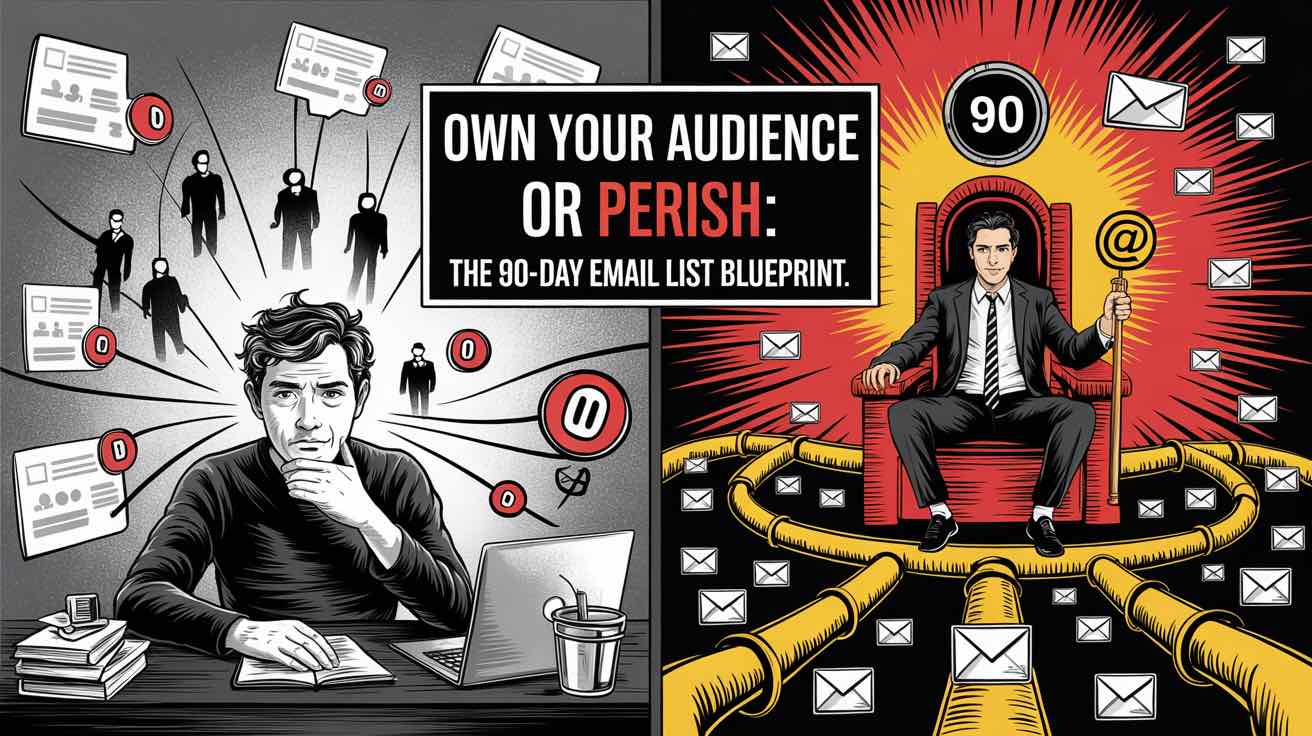
    BUILD A 10K EMAIL LIST IN 90 DAYS

    Your online course launch is approaching fast. You’ve poured countless hours into creating exceptional content. The slides are polished. The videos are edited. Everything looks perfect.

    But you’re living in yesterday’s world with today’s tools—and it’s a recipe for disaster.

    The Old World: Build it and they will come. Create great content, share it on social media, and watch the sales roll in.

    The New World: Platforms have become walled gardens. Algorithms hide your content. Tech giants prioritise their profits over your visibility. The digital landscape has fundamentally shifted beneath your feet.

    In 2025, having brilliant content without a substantial email list isn’t just risky—it’s suicidal for your business.

    No list = no sales. Period.

    While everyone else fights for fleeting attention in increasingly crowded, algorithm-controlled spaces, smart creators are building the one asset that transcends platform changes: a direct line to their audience’s inbox.

    The brutal truth? The window for building this asset is closing fast. Each day, privacy changes tighten. Each month, acquisition costs rise. Each year, the barriers to entry grow higher.

    If you can’t capture attention and convert it to owned media now, your brilliant course will die in obscurity—not because it lacks value, but because the distribution channels you’re counting on no longer work like they used to.

    Successful course creators today aren’t just creating differently—they’re distributing differently. They recognise that in this new world, the email list isn’t just another marketing channel—it’s the foundation everything else is built upon. It’s the difference between being at the mercy of tech giants and owning your business destiny.

    Want 10,000 hungry subscribers ready to purchase your course in just 90 days, before these opportunities disappear completely? Let’s break down the exact system that works in today’s reality—no fluff, no outdated theory, just proven tactics that deliver results in the new digital landscape. Here’s how to grow your email list.

    WHY EMAIL DOMINATES EVERYTHING ELSE

    The data doesn’t lie. Email marketing generates $36 for every $1 spent—crushing every other digital channel. While social platforms change algorithms weekly and paid ads grow more expensive daily, email remains the most direct, reliable path to your ideal buyers.

    Email isn’t just another marketing channel—it’s your business lifeline. It’s the difference between launching to crickets and launching to credit card notifications.

    Consider this: a modest 2% conversion rate on a 10,000-person list equals 200 sales. At a $997 course price point, that’s $199,400 from a single launch. Now you understand why building your email list isn’t optional—it’s essential.

    You may be wondering, as a course creator, can you build an email list from scratch?

    Is 10,000 subscribers in 90 days actually realistic?

    Yes, with disciplined execution. This isn’t about magical thinking—it’s about mathematics. To reach 10,000 subscribers in 90 days requires averaging 111 new subscribers daily. Break that down further: with a 40% conversion rate on your opt-in page, you need 278 daily visitors. With strategic implementation of the marketing strategy below, this is entirely achievable.

    Do I need a massive marketing budget?

    No. While strategic paid advertising accelerates growth, many course creators build substantial lists using primarily organic methods. The system works regardless of your starting budget. Begin with the free strategies, then reinvest early revenue into paid amplification.

    How targeted should my list be?

    Ruthlessly targeted. A list of 10,000 random email addresses is worthless. A list of 10,000 people desperately seeking the exact solution your course provides is priceless. Every strategy in this system prioritizes quality over quantity. We’re building a buyer list, not a vanity metric.

    THE 5-STEP SYSTEM to RAPIDY BUILD AN EMAIL LIST

    STEP 1: CREATE AN IRRESISTIBLE LEAD MAGNET WITH A UNIQUE MECHANISM

    Your lead magnet is the gateway to your email list. Most creators fail here by offering generic, forgettable content that provides no compelling reason to subscribe.

    The solution? Create a lead magnet built around a unique mechanism—your proprietary approach, framework, or methodology that delivers results differently than anything else available.

    Your lead magnet must:
    – Solve ONE specific, urgent problem
    – Deliver a quick win within 24-48 hours
    – Showcase your unique expertise
    – Naturally lead toward your paid course

    Powerful formats include:
    – A 5-day challenge using your signature framework
    – A detailed template incorporating your unique process
    – A comprehensive guide featuring your proprietary method
    – A video masterclass revealing your exclusive approach

    For example, if your course teaches Instagram growth, don’t offer a generic “Instagram Tips” PDF. Instead, create “The 3-Day Reels Acceleration Challenge: How to Double Your Engagement Using the Visibility Vortex Method.”

    The specificity, urgency, and unique mechanism make this irresistible to your ideal subscribers. Plus, you can include a newsletter as a bonus, or the lead magnet as the bonus to your newsletter. 

    STEP 2: LEVERAGE HIGH-TRAFFIC CHANNELS WITH STRATEGIC PRECISION

    Content creation alone isn’t enough. You need systematic distribution across platforms where your ideal buyers already spend time.

    The Ladder of Beliefs: Building Conviction Through Content

    Every piece of content you create must strategically move your audience up the “ladder of beliefs”—a psychological progression that transforms casual viewers into eager subscribers and buyers. Your content should systematically address:

    1. Bottom Rung: Problem Awareness – Content confirming they have the problem you solve
    2. Second Rung: Solution Awareness – Content revealing solutions exist (without pitching yours yet)
    3. Third Rung: Method Awareness – Content highlighting your unique approach/mechanism
    4. Top Rung: Product Awareness – Content connecting your lead magnet to their desired outcome

    For each platform, create content addressing all four rungs, with special emphasis on the middle two, which build the strongest conviction.

    Answering the 4 Critical “Whys” in Every “New Subscribers” Campaign

    Additionally, your content must systematically answer the four questions every “target audience” prospect subconsciously asks before subscribing:

    1. Why You? – Content demonstrating your unique expertise, background, and credibility
       Example: “How I went from struggling course creator to 7-figure launches using this exact email campaigns system”

    2. Why Me? – Content showing you understand their specific situation and challenges
       Example: “The 3 reasons most course creators fail to build their email list (and why it’s not your fault)”

    3. Why This? – Content highlighting what makes your approach different and superior
       Example: “Why traditional email list building advice fails in 2025 (and what works instead)”

    4. Why Now? – Content creating urgency and consequences for delay
       Example: “The closing window: Why waiting even 30 days to build your email list will cost you thousands”

    For each platform:

    Social Media Domination For Your Email List Building:

    – Create a content calendar ensuring you address all ladder rungs and 4 whys weekly
    – Identify 3-5 core pain points your audience experiences
    – Create daily content addressing these specific struggles
    – Include clear, direct calls-to-action to your lead magnet
    – Engage with every comment, building relationships
    – Use platform-specific features (Stories, Reels, Lives) to increase visibility
    – Implement the “Problem-Agitate-Solution” formula in every post

    YouTube & Podcast Penetration to Raise Your Online Course Awareness:


    – Create cornerstone content pieces (15-30 minutes) that deeply explore your audience’s challenges
    – Structure content to methodically climb the belief ladder
    – Explicitly address each of the 4 whys throughout your content
    – Embed multiple mentions of your lead magnet throughout
    – Create custom URLs for easy verbal referencing
    – Include timestamps directing to solution sections
    – Repurpose long-form content into platform-specific snippets
    – Collaborate with established creators in adjacent niches

    Strategic Partnerships:


    – Identify 20 potential partners with audiences overlapping yours
    – Create a compelling partnership proposal emphasizing mutual benefit
    – Offer to create exclusive content for their audience
    – Suggest joint webinars or challenges with shared list-building goals
    – Implement cross-promotions with clear tracking

    The key difference between mediocre and explosive growth lies in execution consistency. Commit to daily content creation and distribution across at least three high-traffic channels simultaneously.

    STEP 3: LIST BUILDING STRATEGIES – IMPLEMENT VIRAL GIVEAWAYS AND CONTESTS

    Strategic giveaways can generate thousands of subscribers in days when properly executed.

    Critical elements for giveaway success:
    – Prize selection that attracts only your ideal buyers (avoid generic prizes like iPads)
    – Entry mechanisms that require email subscription plus social sharing
    – Viral multiplier incentives (more entries for referring friends)
    – Clear timeframe creating urgency (7-14 days maximum)
    – Transparent winner selection process building trust
    – Follow-up sequence for non-winners offering special consolation value

    Example structure: “Win My Complete Course Creation System ($2,997 value) by entering your email and sharing this post. Each friend who enters through your link gives you 3 additional entries.”

    This approach ensures rapid list growth while maintaining subscriber quality through strategic prize selection.

    STEP 4: ACCELERATE GROWTH WITH TARGETED PAID ADVERTISING

    Once your organic systems demonstrate positive results, amplify winning strategies with paid advertising.

    Focus your initial ad budget on:
    – Retargeting website visitors and video viewers (lowest-hanging fruit)
    – Promoting your highest-converting lead magnet to cold audiences
    – Testing multiple creative variations simultaneously (minimum 5 per campaign)
    – Implementing the “Testimonial Sandwich” ad format (problem → solution → proof)
    – Creating custom audiences based on engagement behaviors
    – Developing lookalike audiences from your existing subscribers

    Structure your ad campaigns to address the 4 whys:
    Why You ads featuring your credentials and results
    Why Me ads speaking directly to audience pain points
    Why This ads highlighting your unique mechanism
    Why Now ads emphasising urgency and consequences of delay

    Even modest daily budgets ($20-50) can dramatically accelerate list growth when targeting is precise and creative resonates deeply with your ideal audience.

    STEP 5: OPTIMISE LANDING PAGE CONVERSION PATHWAYS

    The difference between a 20% and 60% opt-in rate lies in landing page optimisation.

    Your landing pages must:
    – Open with a headline addressing a specific pain point
    – Present your lead magnet as the immediate solution
    – Highlight your unique mechanism differentiating your approach
    – Include 3-5 bullet points of specific benefits (not features)
    – Incorporate social proof from previous subscribers
    – Use a simple, prominent opt-in form (fewer fields = higher conversion)
    – Remove all navigation and distractions
    – Include urgency elements (limited availability, timers)
    – Feature a compelling call-to-action that emphasizes value, not work

    Critically, ensure your landing page explicitly addresses all 4 whys:
    – Why You – Brief credibility section establishing your authority
    – Why Me – Copy that speaks directly to visitor’s specific situation
    – Why This – Clear explanation of what makes your lead magnet unique
    – Why Now – Compelling urgency elements and consequences for delay

    Test multiple variations simultaneously, focusing on headline and call-to-action optimization first, as these elements drive the largest conversion improvements.

    EMAIL MARKETING RETENTION AND ENGAGEMENT STRATEGIES

    Building your list is only half the battle. Maintaining engagement ensures your subscribers remain responsive when you launch your course.

    Implement these critical engagement tactics:
    – Send immediate value within 15 minutes of subscription
    – Create a strategic welcome sequence introducing your core philosophy
    – Segment subscribers based on behavior and interests
    – Maintain consistent delivery schedule (same days/times)
    – Use story-driven emails creating emotional connection
    – Incorporate open loops maintaining curiosity
    – Regularly clean your list removing unengaged subscribers
    – Implement re-engagement campaigns for declining interest
    – Survey subscribers quarterly for feedback and preferences

    Structure your email sequences to continue building belief:
    – Early emails focus on problem and solution awareness
    – Middle emails establish your unique method
    – Later emails prepare subscribers for your product offering

    Remember: an engaged list of 5,000 will outperform a disinterested list of 20,000 every time.

    REAL-WORLD EMAIL LIST SUCCESS IMPLEMENTATION

    Consider Jenna Kutcher’s rapid list-building journey. Starting with zero subscribers, she implemented this exact system—creating her signature “Instagram Lab” lead magnet, distributing strategic content across platforms, partnering with complementary creators, and optimizing her conversion pathways.

    What made Jenna’s approach particularly effective was her masterful use of the belief ladder and 4 whys framework. Her content systematically built conviction by addressing each rung of the ladder, while her campaigns explicitly answered why her audience should trust her specifically, why her approach was uniquely suited to their situation, why her method was superior, and why immediate action was essential.

    Within 90 days, she built a list exceeding 10,000 subscribers. Within a year, that list generated over $1 million in course sales. The system works when implemented with discipline and consistency.

    YOUR ONLINE COURSE ACTION PLAN STARTS NOW

    Building a 10,000-person email list in 90 days isn’t just possible—it’s a predictable outcome when you follow this system with unwavering commitment.

    Start today:
    1. Create your unique mechanism lead magnet this week
    2. Map out your ladder of beliefs and 4 whys content strategy
    3. Implement daily content distribution across three platforms
    4. Launch your first strategic giveaway within 14 days
    5. Begin testing paid amplification by day 30
    6. Continuously optimise your conversion pathways

    The difference between course creators who struggle and those who thrive isn’t talent or luck—it’s the strategic asset of a responsive email list built through psychological understanding and systematic execution.

    Your move. Your future launches depend on it.

    FAQ How to Build An Email List for Selling Courses

    Q: How can a course creator build an email list from scratch?

    A: Starting from zero subscribers feels like trying to fill a swimming pool with a teaspoon, but don’t panic!

    Begin by creating a simple opt-in form on your website where visitors can sign up for your email newsletter.

    Next, create a lead magnet (like a free guide or mini-course) that solves a specific problem for your ideal students.

    The secret sauce? Make sure your sign-up process is easier than ordering pizza online. Before you know it, you’ll have complete strangers willingly exchanging their email addresses for your wisdom, and your funnel will start filling up with potential students!

    Q: What’s the best way to create a lead magnet that actually grows your email list?

    A: Think of your lead magnet as the digital equivalent of those free samples at Costco – but without the awkward person in the hairnet!

    The best lead magnets solve a specific problem that gives people a taste of what your full course offers. Try creating a free resource like a cheat sheet, checklist, or mini-course that provides immediate value.

    The magic happens when people think, “If their free stuff is this good, their paid course must be amazing!” Just remember: if people are willing to trade their precious email address for what you’re offering, you’re on the right track to building your online course empire!

    Q: Which email marketing software is best for course creators?

    A: Choosing email marketing software is like picking a roommate – you’ll be spending A LOT of time together, so choose wisely! Popular options include ConvertKit (super user-friendly for beginners), ActiveCampaign (great for sophisticated email automation), Mailchimp (the OG with a generous free plan), or Flodesk (pretty templates for the aesthetically-inclined).

    The “best” option depends on your tech comfort level, budget, and how fancy you want your email automation to be. Just pick one and start building – you can always switch later if you discover your email software has annoying habits, like leaving digital dishes in the sink!

    Q: How can I create an email list for free when I’m just starting out?

    A: Being broke doesn’t mean you can’t build an email empire! Start with free tiers of email marketing platforms like Mailchimp (up to 2,000 subscribers), MailerLite, or SendinBlue.

    You can create an email list without spending a dime by focusing on organic methods: utilize free social media platforms to promote your lead magnet, guest on podcasts where your target audience hangs out, or write guest posts for related blogs.

    The funnel starts when you convince people to sign up for your email newsletter with the promise of valuable content. It’s like throwing a party with no budget – you can’t offer fancy appetisers, but with enough enthusiasm and a clear value proposition, people will still show up!

    Q: What should I include in my welcome email to new subscribers?

    A: Your welcome email is like a first date – it sets the tone for your entire relationship! Start with a hearty “thanks for joining” (but maybe hold off on the marriage proposal).

    Deliver whatever goodies you promised in exchange for their email address immediately. Next, briefly explain what they can expect from you – content topics, email frequency, and the personality behind the messages.

    Add a personal touch by sharing a quick story or asking a question to encourage replies. Finally, include a clear next step, like checking out your most popular blog post or following you on social media. Remember, this is the start of a beautiful friendship that will hopefully lead to them buying your course, so make it count!

    Q: How often should I send emails when marketing my online course?

    A: Finding the perfect email frequency is like Goldilocks testing porridge – not too hot, not too cold! For most course creators, a consistent weekly newsletter builds relationship without becoming annoying.

    As you’re selling your online course (especially during launches), you’ll want to ramp up frequency – maybe 3-5 emails during launch week. The key is setting expectations upfront so subscribers aren’t shocked when more emails arrive.

    Remember, it’s better to send fewer, value-packed emails than frequent “buy my stuff” messages that make people regret joining your email list faster than you can say “unsubscribe.” The best approach? Test different frequencies and watch your open rates to see what your audience prefers!

    Q: What are some creative ways to grow your email list beyond basic opt-in forms?

    A: If your email list grows as slowly as a sloth on vacation, it’s time to get creative! Try hosting a free webinar or workshop where registration requires an email address.

    Create quizzes related to your course topic that deliver personalized results via email. Start a challenge that participants join via email sign-up.

    Guest on podcasts with a special offer for listeners. Set up your email opt-in form on multiple pages of your website, not just the homepage.

    Run a giveaway of resources your audience actually wants. Partner with complementary course creators for list-building bundles.

    The funnel gets fuller when you think beyond basic “subscribe to my newsletter” buttons. Remember, people need a compelling reason to invite your marketing emails into their already crowded inbox!

    Q: How do I use my newsletter to increase online course sales?

    A: Your newsletter is like a party where you’re both the host AND the guest of honor! The secret to sell more online courses through email? Provide so much value that paying for your course feels like the natural next step.

    Start by segmenting your list so you’re sending targeted content based on interests. Share case studies of successful students, behind-the-scenes peeks at your course creation process, and answer common questions.

    Sprinkle in testimonials naturally. Occasionally offer special deals or bonuses exclusively for subscribers. The best part? Unlike social media, once someone’s on your email marketing list, you own that connection – no algorithm can come between you and your potential students.

    As your list grows, your business grows too, and soon you’ll be sending emails from your yacht. Well, maybe a small yacht, but still!

    Q: How long does it take to build an effective email list for selling courses?

    A: Asking how long it takes to build an email list is like asking how long it takes to become a good dancer – it depends on your moves! Most course creators need 3-6 months of consistent effort to build a responsive list that generates sales.

    But here’s the funny truth: it’s not about the size. (Email marketers say this a lot, I promise.) A highly-engaged list of 500 people who open everything you send will generate more online course sales than 5,000 people who forgot they subscribed.

    Focus on quality over quantity as you start building. The good news? Once you set up your email automation with a solid welcome sequence, much of the work happens while you sleep! Just keep creating valuable content, and before you know it, your list will be generating sales with every launch!

    Q: What are the biggest mistakes to avoid when creating your email list for courses?

    A: Want to know how to sabotage your email list faster than you can say “spam folder”? First, buy email addresses instead of earning subscribers organically (nothing says “trust me with your education” like unsolicited emails!).

    Second, forget to set up basic email automation like welcome sequences, leaving new subscribers wondering if they’ve joined a ghost town.

    Third, make your sign-up process more complicated than assembling IKEA furniture.

    Fourth, promise weekly tips but disappear for months, then suddenly reappear only when you’re selling something.

    Fifth, send nothing but promotional content without providing value first. And the grand finale of email list disasters? Forgetting to comply with email laws like including an unsubscribe option. Avoid these mistakes, and you’ll be light years ahead of many course creators who wonder why their list isn’t converting!